Research


A Data-Driven Planetary Model for Parent-Child Dynamics
Understanding how parents and adolescents influence one another is central to research on family dynamics, mental health, and development. To investigate these processes, researchers conduct longitudinal studies in which parent-child dyads complete repeated questionnaires. Traditional analysis approaches to such data typically rely on linear models and group averages. While effective in demonstrating strong effects, these methods fall short of capturing the richness and complexity of dyadic interactions and dynamics.
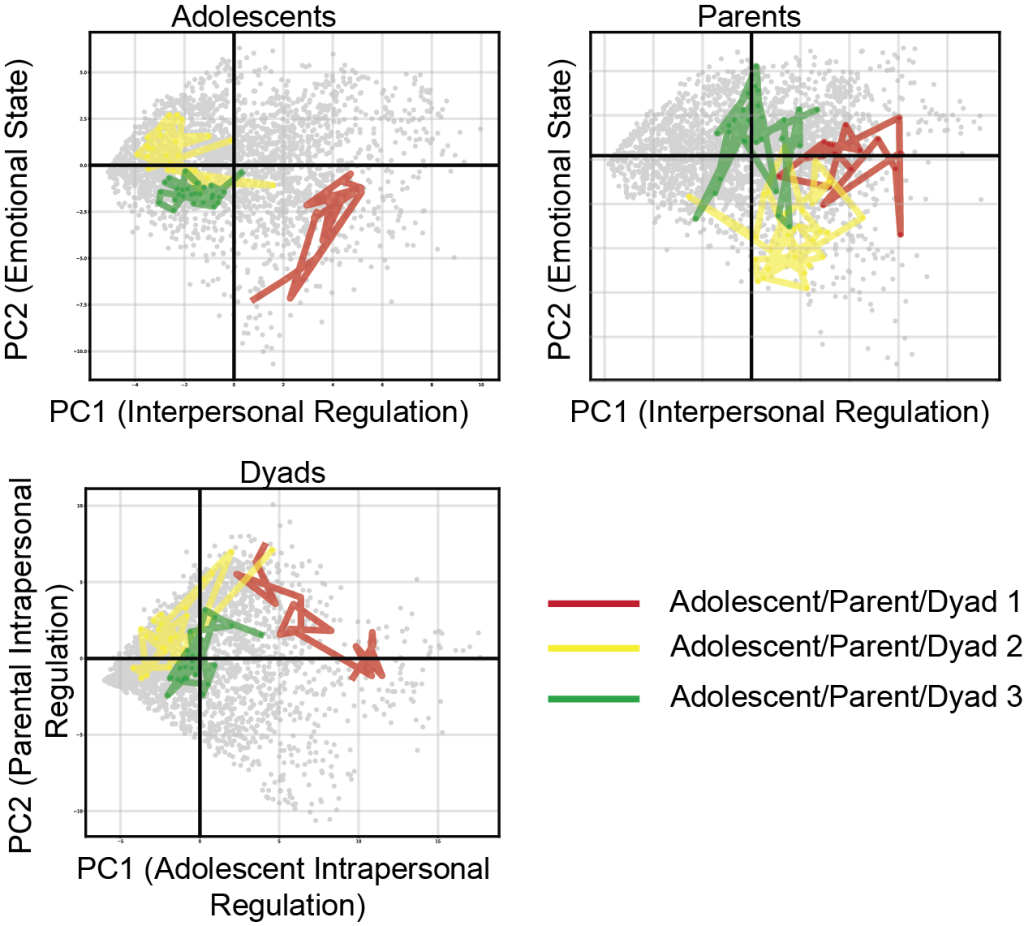
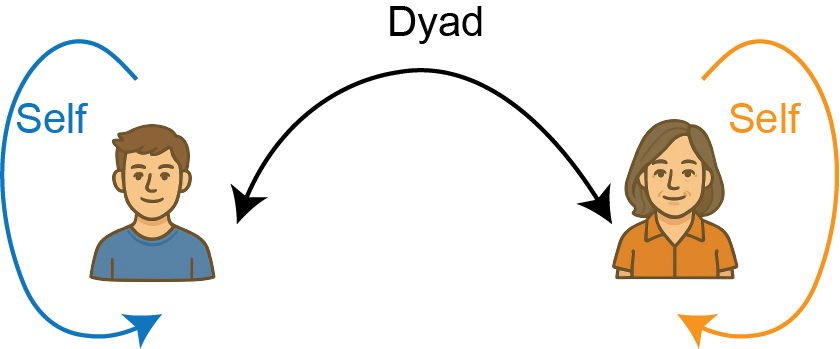
In this study, we propose a dynamic, data-driven framework for analyzing parent-child dyads, inspired by the two-body problem in physics. We conceptualize parents and adolescents as two interacting planetary bodies, each following its own trajectory while simultaneously exerting influence on the other. We utilize data science tools to extract the latent dynamics of each participant (parent or child) and of the dyad as a whole. Then, adapting the two-body formulation, we will consider the dyad trajectory as the trajectory of the center of mass. We will further use the estimated dyad trajectory to evaluate the “relative mass” of each individual, to identify who sets the tone in the relationship in terms of emotional state and mental health. Finally, we will characterize the dyads and tone-setters at the population level to extract indicators for positive dynamics, such as resilience and low depressive symptoms, as well as indicators for negative dynamics, including persistent conflicts and high depressive symptoms.
This research integrates psychological science and mathematical modeling to capture the complexity of parent-child interactions. Beyond advancing theory, the framework has practical implications for designing interventions that target not only individual mental health but also the relational patterns that shape it. By treating family systems as dynamic and interactive rather than static snapshots, our approach offers a novel lens on the mechanisms of influence within parent-child dyads.