Research


Unsupervised framework for discovering functional neuronal ensembles from population dynamics
High-dimensional neural recordings provide unprecedented access to brain-wide population dynamics, yet interpreting these signals remains a major challenge. Most existing analyses rely on external information, such as known stimuli or behavioral labels, to better understand the network’s dynamics. Moreover, these analyses are often applied in a univariate manner, treating neurons as independent. Biologically, meaningful neural representations typically arise from ensembles of interacting neurons rather than from individual cells, making such supervised, univariate approaches insufficient for capturing collective dynamics in an unbiased way.
Here, we propose GroupFS, a novel, data-driven method that 1) groups together co-active cells and 2) ranks the groups by their importance to the overall dynamics, without requiring supervision or external labels. GroupFS preserves the intrinsic geometry of the data by constructing two graphs, one over samples and one over features, that capture temporal and neuronal relationships. Enforcing smoothness across both graphs encourages neurons with similar activity patterns to form coherent subpopulations while suppressing noise and redundancy. The result is a compact, interpretable representation of population activity that reveals the organization of neural dynamics.
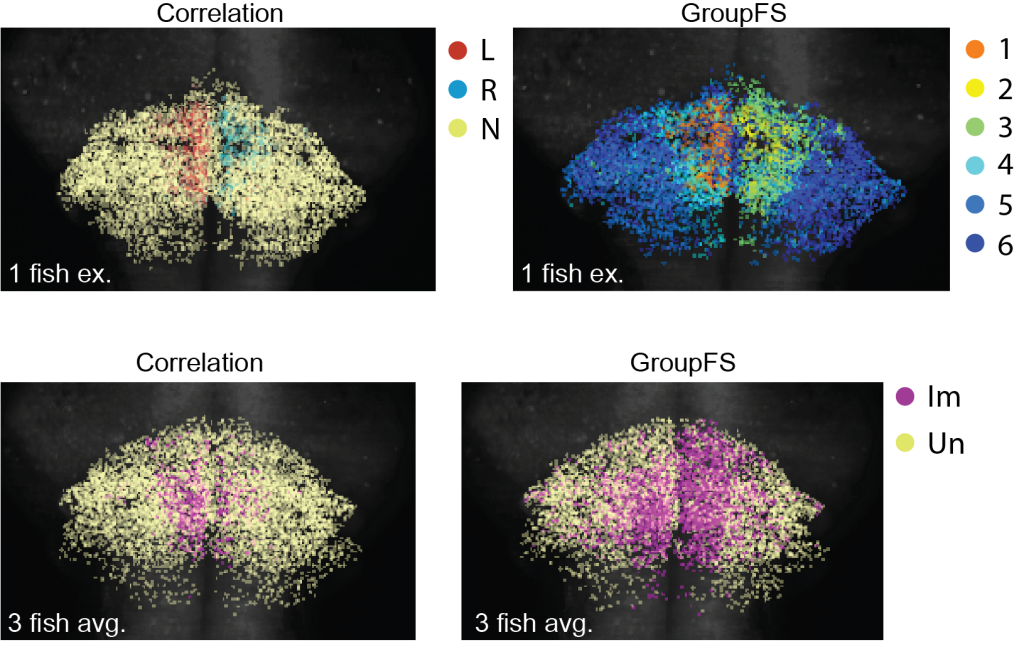
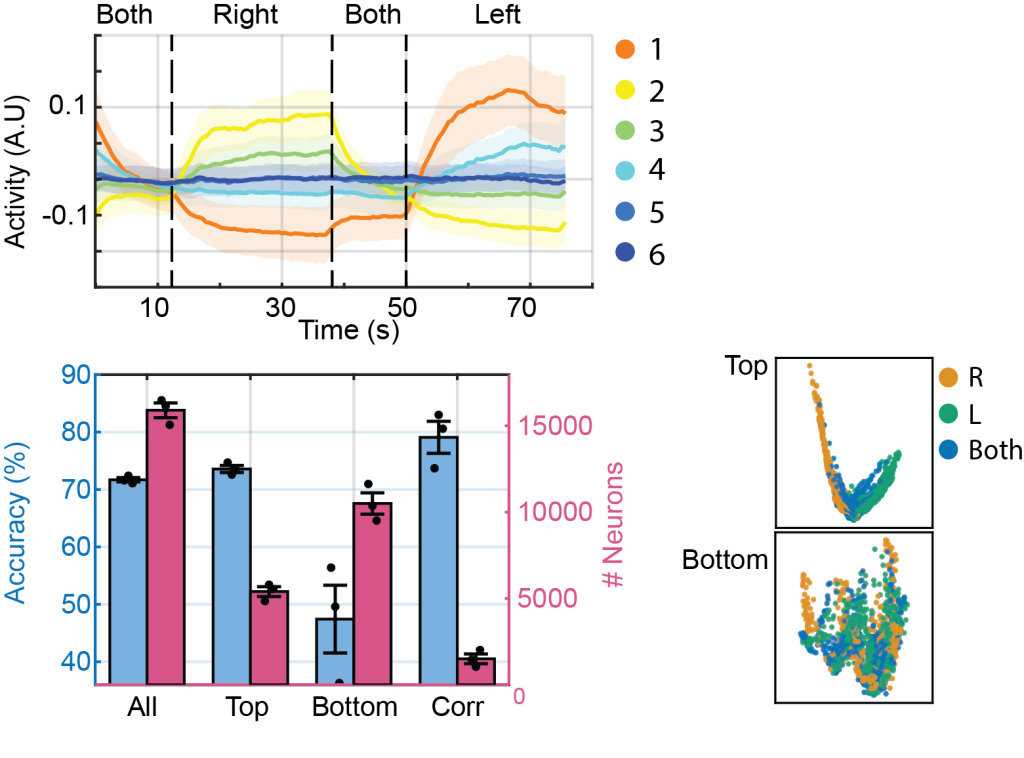
Here we apply GroupFS to whole-brain light-sheet recordings in larval zebrafish exposed to visual stimuli. Our model uncovered neuronal ensembles in the anterior hindbrain tuned to distinct stimulus conditions, regions previously identified as sensorimotor convergence areas in supervised analyses. These patterns, however, emerged here directly from the data, reflecting coordinated neuronal interactions. By revealing such structures in an entirely unsupervised manner, GroupFS enables researchers to uncover how network activity is organized internally and to relate these ensembles to behavior or sensory context, providing a powerful and interpretable tool for large-scale neural recordings.