Research


A Multimodal, Data-Driven Analysis of Brain–Behavior Relationships Across Pregnancy in First-Time Mothers
Every year, around 140 million women experience pregnancy, a major life transition marked by extensive psychological and biological changes. While these processes are well documented, most existing research examines them in isolation, using either behavioral measures or neuroimaging data alone. As a result, the dynamic relationship between psychological trajectories and neural reorganization across pregnancy remains poorly understood.
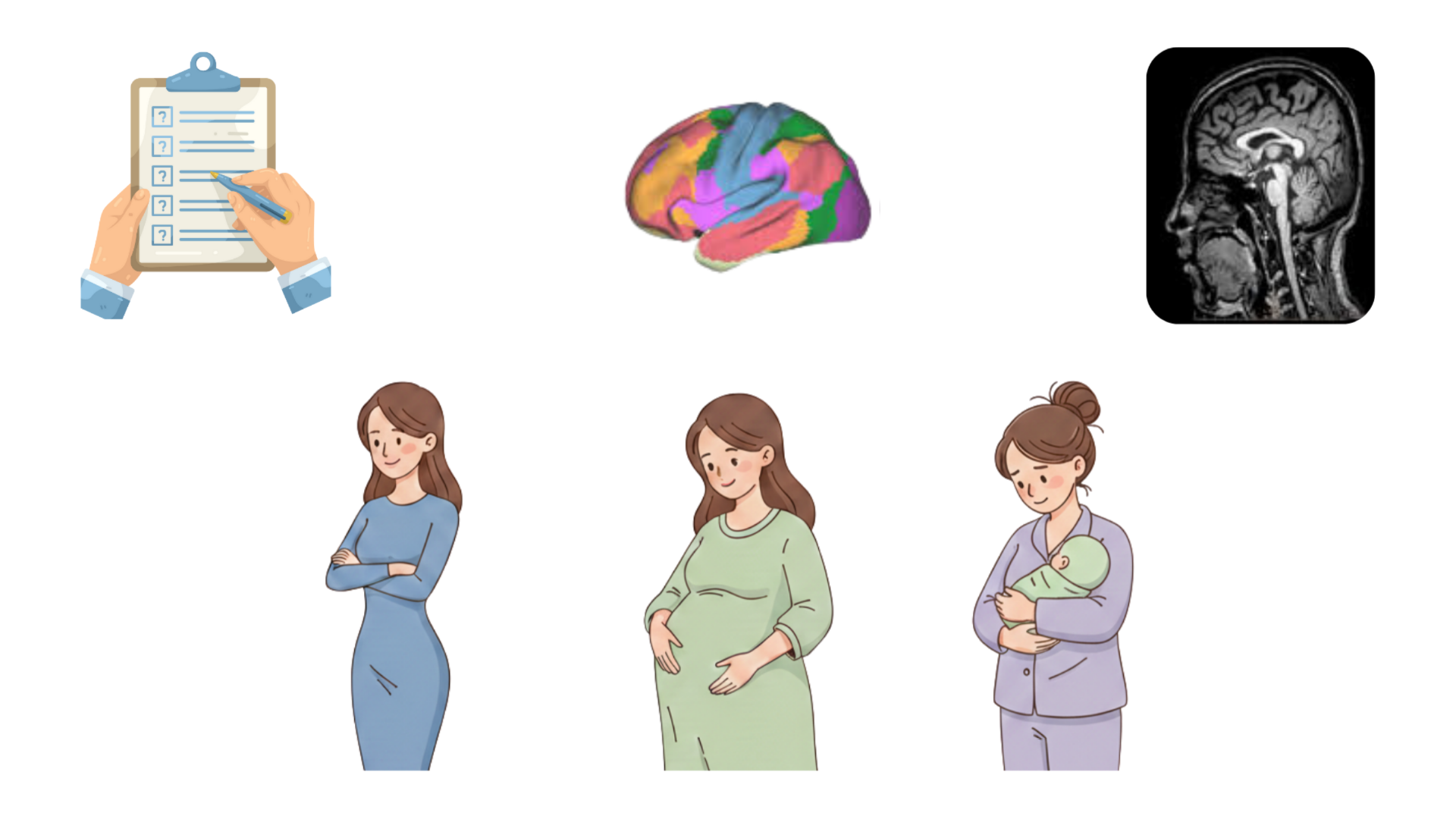
Our work seeks to bridge this gap by leveraging a longitudinal, multimodal dataset that combines behavioral questionnaires with structural and resting-state functional MRI, collected across multiple stages of pregnancy. A central question guiding this work is whether women’s psychological health prior to pregnancy is associated with how they adapt to the transition into motherhood, and whether such differences are reflected in brain organization over time.
To examine this, we apply dimensionality reduction techniques to uncover meaningful patterns within the high-dimensional data. We fuse multiple modalities, including functional connectivity modeled as symmetric positive definite (SPD) matrices, alongside Euclidean behavioral and structural features, to reveal both shared and modality-specific latent structures. This framework supports later predictive analyses of pregnancy outcomes (e.g., maternal attachment, birth experience), ultimately advancing our understanding of the psychological-neural relationship during this critical life transition.